




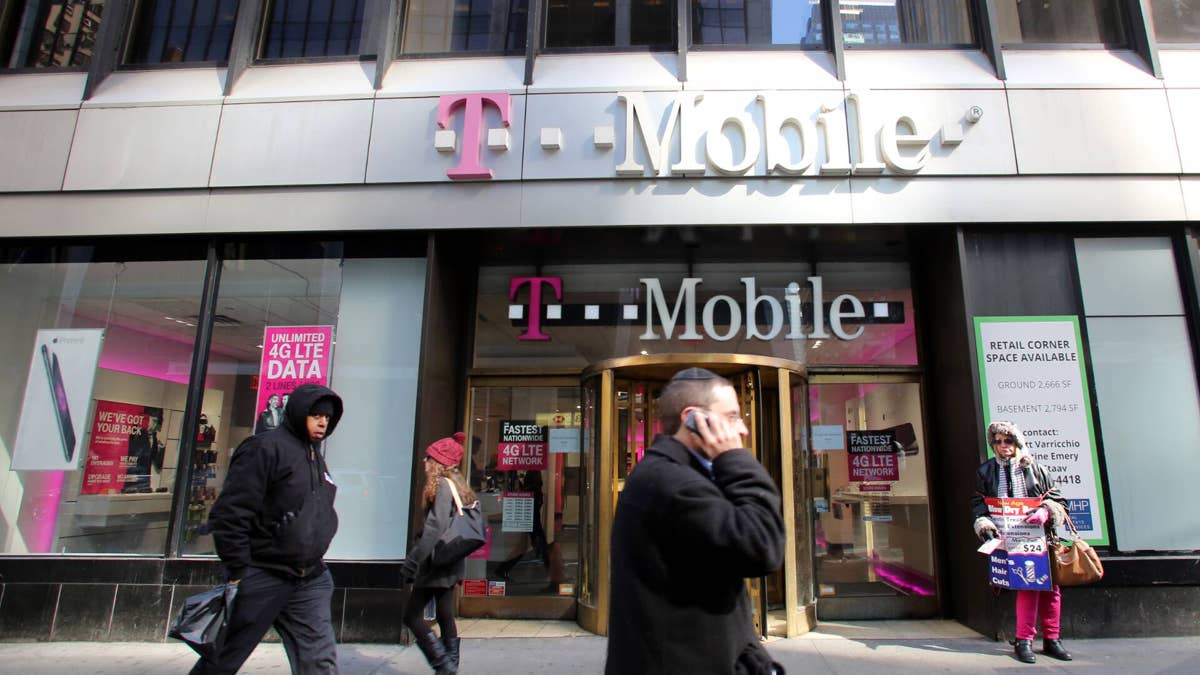

Since last fall, T-Mobile has been led by Srini Gopalan, who officially became CEO on Nov. 1. He has repeatedly expressed his goal of making T-Mobile a digital-first company and has recently been ushering in companywide changes to achieve it.
While this initiative has previously sparked criticism from employees and customers, a leaked internal memo has revealed that T-Mobile isn’t backing down and is planning a major shift in the next few months.
In October, Gopalan said during an earnings call that T-Mobile will be undergoing a digital transformation to tackle the “friction and frustration” it causes customers with its “processes.”
Since then, T-Mobile has increasingly digitized its services. On Oct. 30, it began requiring customers to use its T-Life app to set up pay arrangements for past-due account balances.
In December, it launched a new digital switching tool, “Easy Switch,” on its T-Life app and website, allowing consumers to switch to its network in 15 minutes or less.
It has also recently partnered with DoorDash to offer free same-day delivery of its phones and accessories, and later its 5G Home Internet equipment, reducing the need for customers to visit stores for assistance.
T-Mobile has even added a feature in its T-Life app to help customers compare phone plan prices, decreasing the need to contact customer support.
As T-Mobile leans further into becoming digital-first, it has conducted layoffs in December, January, March and April. These job cuts have affected departments such as IT, sales, consumer and retail, end-user support, and product.
Leaked T-Mobile memo reveals major shift in digital push
Currently, T-Mobile expects to generate $3 billion in savings by 2027 from its artificial intelligence and digital initiatives. During an earnings call in February, Gopalan said that the company’s digitalization has been a “three-year journey.”
“Step one was building the capabilities, having our IT in place, having the digital in place,” said Gopalan. “Step two was customer adoption, which is actually working with customers in moving them to assisted digital. And step three is now scaling.”
Amid this shift, a leaked internal memo has revealed that T-Mobile plans to require existing customers and employees to use the T-Life app to make key account changes by the end of July, according to a recent report from The Mobile Report.
Related: T-Mobile rolls back 2 customer discount changes after backlash
In the memo, T-Mobile Chief Operating Officer Jon Freier tells employees that this will impact 100% of phone upgrades and new line additions for existing customer accounts.
“In July, we are planning to have 100% of consumer upgrade and 100% of consumer add-a-line transactions now eligible in T-Life,” wrote Freier in the memo.
He said that T-Mobile will completely remove access to its “old worn out 1990s legacy systems” for these transactions by Aug. 1.
“Every upgrade and add-a-line transaction whether done in a store, over the phone, from the couch, wherever, will be done exclusively in T-Life as of August 1,” wrote Freier.
More T-Mobile News:
- T-Mobile customers set to receive a significant network upgrade
- T-Mobile revives free perk for customers amid challenges
- T-Mobile adds convenient new offering for customers
The company will do the same for new customer accounts before Oct. 1. Freier said that T-Mobile’s T-Life transition has been successful in making the customer experience more seamless.
“There are 30% fewer calls to Customer Care when a new customer joins T-Mobile through T-Life,” he said. “We’re seeing more new account revenue when transacting in T-Life vs. legacy systems because of the consistent T-Life journey flow.”
“We’re seeing, on average, a 25% faster system transaction time for T-Life upgrades with 50% fewer clicks,” he continued.
Some T-Mobile employees are raising concerns about the change
In response to this change, some T-Mobile employees took to social media platform Reddit to express frustration.
“They want customers to do it all through tlife but the customers aren’t the ones doing it…WE ARE. Which is super frustrating bc Tmobile is making it seem like customers are making tlife BOOM with usage when in reality it’s us! They’re making our job harder,” wrote one employee on Reddit.
“I’m hoping they let us keep our tablets but add T-life access to those in case of broken/ stolen phones etc. I’m not in support of this decision regardless but there’s gotta be some kind of backup plan. ‘Pleased to tell you all, you’re job is getting harder and taken by an app,’” wrote another.
“Our local stores started having to use tradein phones for customers unable to get into Tlife. Take the wiped phone, set it up without any information and use it to set up the account before wiping it again. It’s such a pain in the a*s, and it makes customers look at us funny because we’re having to jump through so many hoops for something that should be simple,” wrote another employee.
The move from T-Mobile follows customer backlash the T-Life app faced last year for being difficult to use. Some customers have reportedly even walked out of stores in frustration with the app.
T-Mobile’s big bet on leveraging T-Life to simplify the customer experience also comes after a recent JD Power survey found it falling behind mobile virtual network operators (MVNOs) in consumer satisfaction with postpaid phone plans.
Consumer ratings highlight top-performing U.S. wireless carriers:
- Traditional U.S. wireless carriers earned an average customer satisfaction rating of 603 (out of a 1,000-point scale) for postpaid plans.
- T-Mobile leads this category with a score of 631, ahead of Verizon at 593 and AT&T at 587.
- MVNOs outperformed traditional carriers, posting an average satisfaction score of 630.
- Among MVNO providers, Consumer Cellular ranked the highest with a score of 721, followed by Google Fi Wireless at 685 and Spectrum Mobile at 614.
Source: JD Power
The latest customer satisfaction rankings suggest consumers are placing greater importance on service and support after signing up for wireless plans.
Carl Lepper, senior director of technology, media and telecom at J.D. Power, said in a statement that those day-to-day interactions, such as “resolving issues, managing bills and getting answers quickly,” are becoming critical for customer retention.
“These experiences drive advocacy and long-term retention,” said Lepper. “When interactions are effortless, it shows in low churn and high satisfaction.”
He added that carriers should focus more on retaining existing customers than on attracting new ones.
“For wireless carriers, the best strategy is simple: take care of the customers they already have,” he added.
T-Mobile is struggling with customer retention
It is vital for T-Mobile to improve its customer experience as it is currently battling a recent spike in customer losses.
During an earnings call in April, Gopalan revealed that the company’s postpaid phone churn, the percentage of customers who canceled their postpaid phone service, spiked by 3 basis points year over year in the first quarter of 2026.
This shift in customer behavior follows recent price increases and heightened competition. Gopalan said that “January was particularly competitive and particularly heavy in one-dimensional competition based on subsidies.”
MoffettNathanson analyst Craig Moffett said in a report obtained by Investor’s Business Daily that promotional activity in the wireless industry is leading to tougher competition.
“It seems all but irrefutable that competitive intensity is rising,” said Moffett. “Promotionality is increasing and handset upgrade rates are rising.”
Related: Verizon adds generous offers for customers after price increase